
Review · CYPRUS
Paphos: Discover Scuba Diving Half-Day Tour
Paphos gives beginners an unusual first scuba experience: you can swim over an ancient Roman harbour only minutes after learning to breathe underwater. The route reaches 5 metres and may include Roman amphorae, old anchors, and, in summer, green sea turtles.
I like the calm progression from pool practice to the sea, and I like the small groups, capped at eight people. Instructors including Mick, Pavlos, Sophie, Eva, Chris, and Emma have earned praise for patient explanations and steady support. The main drawback is that three hours includes a fair amount of instruction, so your actual time in the open water is limited.
Key points to know
- Pool first, sea second: You practice breathing, ear equalization, equipment use, and basic hand signals before heading outside.
- A 5m Roman Wall site: The shore site is a short three-minute walk from Cydive and suits first-time participants.
- Small groups matter: A maximum of eight allows instructors to give extra help when masks, breathing, or nerves become a problem.
- Underwater sights are genuine: Expect Roman pottery and anchors, with a chance of seeing green turtles in summer.
- Photos cost extra: An underwater photographer may record your session, but pictures and video are not included in the $106 price.
- You must prepare first: Complete the PADI Discover Scuba eLearning course before arriving and bring swimwear, a towel, sunscreen, and a hair tie.
Why this Paphos experience feels different
Many first scuba sessions are mainly about learning equipment in a controlled setting. Here, the training leads to a place with a clear sense of time and place. At the Roman Wall site, you are not simply looking at fish in open water. You may be swimming past pieces of ancient harbour life, including amphorae and anchors.
That combination makes the experience especially appealing if you want more than a generic resort activity. You get an introduction to scuba, but you also see a small part of Paphos from below the surface.
The experience is run by Cydive beside Paphos Harbour. English and Greek are spoken, and the small-group format is useful for first-timers who need more than one explanation. That matters because underwater communication is limited to hand signals, and a calm instructor can make the difference between continuing and climbing out.
The group size is limited to eight, although the exact number on your date may be smaller. One participant had a session with only one other customer and the instructor, while a family of five received support suited to different ages and abilities.
More Discover Scuba Diving in Cyprus
- Cyprus: Introductory Scuba Lesson and Dive with Transfer
★ 4.9 · 682 reviews - Half-Day Scuba Diving Tour – Discover Scuba Diving!
★ 5.0 · 669 reviews - Discover Scuba diving
★ 5.0 · 504 reviews
What happens during the three hours
The schedule begins at Cydive on Poseidonos Avenue. Allow time to find the centre, especially if you are walking through the harbour area. The meeting point is near Papantoniou Supermarket, down the small road beside it. If you arrive by bus, use the Paphos Harbour stop, cross toward the bakery and ECOSI ice cream shop, then pass through the stone archway.
If you walk along the sea toward the harbour, look for the steps with a metal railing. Cross toward the restaurant side, then use the alley beside The Captains View. Cydive is at the end.
Once there, you receive water, tea, coffee, and fresh fruit. This is a small touch, but it helps while you settle in and complete the opening paperwork. A photograph stop is also listed early in the schedule, though the main underwater photographs are a separate purchase.
The opening safety briefing takes about 30 minutes. You learn how to equalize your ears, use hand signals, and manage the basic skills required during the session. The team also explains the equipment and what each part does.
This briefing is not filler. Equalization is one of the first things that can unsettle a new participant, especially when you are concentrating on breathing through a regulator. You should expect the instructor to repeat or demonstrate anything you do not understand before moving on.
Pool practice before the open water
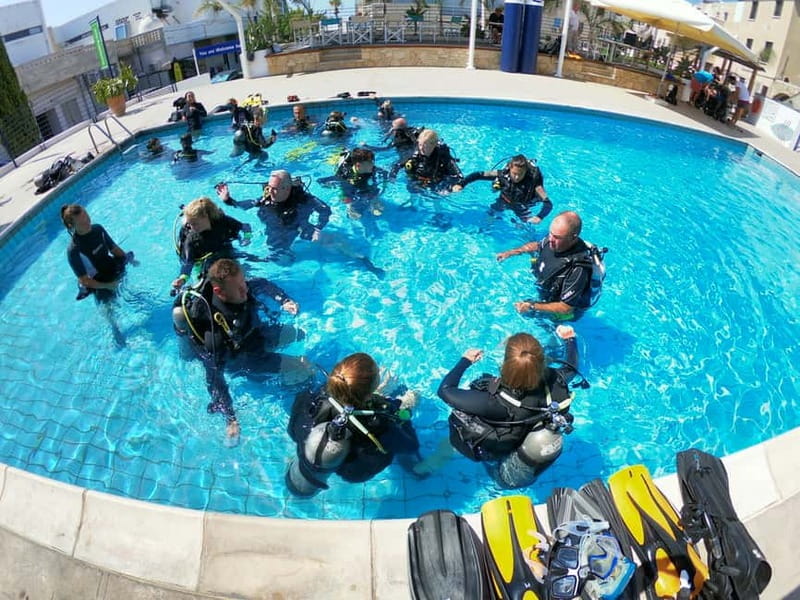
The class and equipment work take about an hour. You put on the wetsuit, boots, mask, fins, and breathing equipment, then enter the training pool for your first breaths underwater.
The pool gives you a safe place to get used to the odd feeling of breathing through equipment. You practice swimming in full gear and move to the deeper end to work on ear equalization. You also rehearse the basic skills that will be used at the sea site.
I like this order because it gives you a chance to discover small problems early. A mask may need adjusting. The sensation of breathing may feel unfamiliar. You may need a few attempts to clear your ears. It is better to solve those issues in the pool than at the shore.
The instructors appear to be particularly strong at handling nerves. Mick is described as clear, patient, and careful about making sure everyone understands before leaving for the sea. Pavlos helped one nervous participant regain confidence, while Sophie, Eva, Emma, Chris, and others have also been praised for calm instruction.
That does not mean the session is effortless. You still need to listen closely and take part in the skills work. If you cannot swim comfortably, you cannot join, and the activity is not designed for someone who simply wants to float while an instructor does everything.
Walking to the Roman Wall site
After the pool and class, you walk for about three minutes to the training site known as the Roman Wall. No vehicle transfer is needed, which keeps the session simple and avoids losing time to transport.
This is a shore-based first experience. You enter the Mediterranean from the coast, rather than boarding a boat and moving straight into deeper water. For a beginner, that can make the setting feel more manageable. You know where you are, the route is short, and the site is chosen for introductory use.
The actual underwater session lasts about an hour. The stated maximum depth is 5 metres, so this is not an advanced descent or a long-distance expedition. The purpose is to use your new skills in open water while an instructor stays with the group.
The site’s appeal comes from its archaeology. You may see ancient Roman amphorae and lost anchors below the surface. Green sea turtles are also a possibility in summer, although no wildlife sighting can be promised. Keep your expectations sensible: the main reward is the chance to experience a historic coastal site from underwater, with marine life as an extra.
The water is described as crystal clear, but visibility and conditions can change. Bad weather may force a reschedule. The sea is also different from the pool, so the instructor may need to slow the pace if someone feels uncomfortable.
Same water, a different dive:
- Private Discovery Dive + Photos & Videos
★ 5.0 · 577 reviews - Try a Scuba Diving Experience
★ 5.0 · 400 reviews - Private Diving at Zenobia Wreck in Larnaka
★ 5.0 · 369 reviews - SCUBA DIVING first time experience
★ 5.0 · 216 reviews
What the instructors do well
For a first session, instructor care matters more than flashy equipment or a long route. Several named instructors receive specific praise for being patient, clear, and attentive. That pattern is useful because beginner scuba often brings two separate worries: breathing through the equipment and entering the open sea.
One participant was nervous about the mask and altered breathing, while another was worried about the ocean and equipment. Both were given time and encouragement rather than being rushed. In another session, an assistant helped one person while the lead instructor continued supporting the rest of the group.
That kind of extra attention is one reason the eight-person limit matters. It does not guarantee a private lesson, but it gives the team a better chance to notice when someone needs help. It also means you should tell the instructor about your concerns early, rather than trying to hide them.
The instructors are not only focused on finishing the route. They explain why the exercises matter and answer questions about future PADI training. Several participants left interested in continuing toward a full certification. If you already suspect that scuba could become a regular hobby, this session can help you decide before committing to a longer course.
Photos, refreshments, and the end of the session
After the underwater portion, there is a further photo stop lasting about 20 minutes. Underwater photographs and video are not part of the $106 price, but a member of the team may record the session and offer the images for purchase.
This is worth knowing before you arrive. If you want a permanent record, budget extra and ask about the cost before the activity begins. If you would rather keep expenses down, the experience itself does not depend on buying photographs.
Back at Cydive, you spend another short period in class, then have coffee or tea for about 15 minutes. Fresh fruit and water are included as well. The full schedule lasts three hours, though the amount of time actually spent in the sea is around one hour.
That balance is normal for a beginner session. You are paying for instruction, equipment, supervision, and access to the site, not just for sixty minutes in the water.
Is $106 a fair price?
At $106 per person, this is not the cheapest way to spend a morning in Paphos. The price makes more sense when you count what is included: a wetsuit and boots, the rest of the scuba equipment, PADI Discover Scuba eLearning, pool instruction, an open-water session, supervision by PADI professionals, and drinks and fruit.
You also avoid the cost and time of a boat transfer. The Roman Wall site is close enough to reach on foot, and the small group can provide more individual attention than a large resort class.
The main extra cost is photography. Towels and sunscreen are also excluded, so bring both rather than buying them at the last minute. If you compare this with a simple snorkelling trip, $106 is a sizeable step up. If you want a structured first scuba session with instruction and equipment included, the price is more defensible.
Free cancellation up to 24 hours before the start time and the reserve-now, pay-later option add useful flexibility. Conditions can change, and you should not feel pressured to attend if you are congested or unwell.
Who should book this activity
This suits a confident swimmer aged 10 or older who wants a carefully supervised first taste of scuba. It is also a good fit for couples or families with mixed levels of confidence, since the pool allows each person to adjust before entering the sea.
The family setup needs one clarification: children under 10 cannot participate, while an 11-year-old was able to take part with a 16-year-old and adults. The activity still demands focus, comfort in water, and the ability to follow instructions.
I would particularly recommend it if you want a historic setting rather than a standard training pool. Seeing Roman material underwater gives the hour in the sea a clear purpose.
It is not suitable for anyone who is pregnant or has epilepsy, heart problems, or respiratory conditions. You must complete a medical questionnaire before the session. If you have a cold or feel congested, reschedule until it has cleared, since pressure equalization can be difficult.
You also need to complete the digital eLearning course before the activity date. Do not leave this until the morning of the session. If it is unfinished, you may need to reschedule.
Practical details that can save you trouble
Bring swimwear, a towel, sunscreen, and a hair tie. Cydive supplies the scuba equipment, wetsuit, and boots, but not towels or sunscreen.
Do not bring a camera or waterproof camera into the activity. Underwater photos and video are handled separately by the team. High heels, smoking indoors, alcohol, drugs, and feeding animals are not allowed.
Plan your flights carefully. You cannot take a plane on the same day as the session, and you should wait at least 12 to 24 hours after scuba before flying.
The tour is offered in English and Greek. If you need a language other than those, this may not be the right choice. Weather can also affect the schedule, so keep some flexibility in your Paphos plans.
Should you book the Paphos Roman Wall session?
Book it if you want a well-supported first scuba experience with a genuine historical setting. The pool practice, short walk to the shore, 5m depth, and small group make the format approachable. The consistently strong feedback about instructors such as Mick, Pavlos, Sophie, Eva, and Emma is also reassuring for anyone who feels nervous.
Skip it if you cannot swim comfortably, have a medical condition listed above, need a long open-water route, or want underwater photos included in the price. For everyone else, $106 buys much more than a quick swim: you learn the basics, use full equipment, and may see Roman harbour remains and a turtle in the same morning.
FAQ
How long does the Paphos scuba experience last?
The activity lasts three hours. This includes refreshments, the safety briefing, classroom instruction, pool practice, the walk to the shore site, about one hour in open water, photographs, and a final drink.
How deep will I go?
The first open-water session reaches a maximum depth of 5 metres.
Do I need previous scuba experience?
No. The activity is designed as a first scuba experience, with a briefing, pool practice, equipment training, and instructor-led open-water session.
Do I need to know how to swim?
Yes. Participants must be comfortable swimmers. People who cannot swim cannot take part.
What equipment is included?
Scuba equipment, a wetsuit, and boots are included.
Are underwater photos included?
No. Underwater pictures and videos are not included in the price. They may be available to purchase separately.
What age must participants be?
Children under 10 cannot take part. The activity is suitable for participants aged 10 and older if they meet the swimming and medical requirements.
Can I fly after the activity?
You should not fly on the same day as scuba. Wait at least 12 to 24 hours after the session before taking a flight.
More half-day trips around Cyprus
- Half-Day White Shark Cage Diving from Gansbaai
★ 4.5 · 310 reviews - From Dubai: Fujairah Half-Day Scuba Dive and Snorkeling
★ 4.7 · 186 reviews - Half-Day Diving in Sal
★ 5.0 · 135 reviews - Half-Day Small-Group 2-Tank Scuba Dive in Key Largo (CERTIFIED DIVERS ONLY)
★ 5.0 · 125 reviews
Newly logged dives around Cyprus
- Protaras: Cape Grecko Single Dive for Qualified Divers★ 4.7 · 13 reviews
- Protaras: Bubblemaker Diving Course & 2-Meter Dive★ 5.0 · 10 reviews
- Paphos: Discover Scuba Diving Experience with Pickup★ 5.0 · 2 reviews
- Protaras: 3-4 Day PADI Open Water Diver in Protaras★ 5.0 · 2 reviews
- Discover Scuba Diving Experience★ 5.0 · 12 reviews
- Ayia Napa: Introduction & MUSAN Museum Dive★ 5.0 · 11 reviews
- Ayia Napa: Beginners Discover Scuba Diving Experience★ 5.0 · 2 reviews
- First Time Scuba Dive Adventure, Makronissos, Ayia Napa★ 5.0 · 12 reviews
Discover Scuba Diving, side by side.
Cyprus: Introductory Scuba Lesson and Dive with Transfer
Read our review →
Half-Day Scuba Diving Tour – Discover Scuba Diving!
Read our review →Lists this dive is on